
The regulator of Australian higher education has published its 2025-26 Annual Report. In it, TEQSA tells Parliament that providers rate it lower, that fewer say it avoids getting in the way, that its Annual Report records a 16 point fall in a staff culture score, and that it missed three of its own 26 targets. Some results are good. The pattern is what matters.

A Regulator Marked by Its Own Report Card
Every registered provider in this country is asked to report against measures, show evidence and improve when results fall. It is reasonable to ask how the regulators score when they apply those tests to themselves.
TEQSA, the Tertiary Education Quality and Standards Agency, has now answered in its Annual Report 2025-26. I read it against its own performance measures. This is what the report says, in its words, with the page of each figure.
Source: TEQSA Annual Report 2025-26, pages 34, 60 and 63. The report describes the first rating as down 6% (unit not stated), the second as down 5 percentage points and culture as down 16 percentage points.
1. Sixteen Achieved, Three Not, Two With No Data
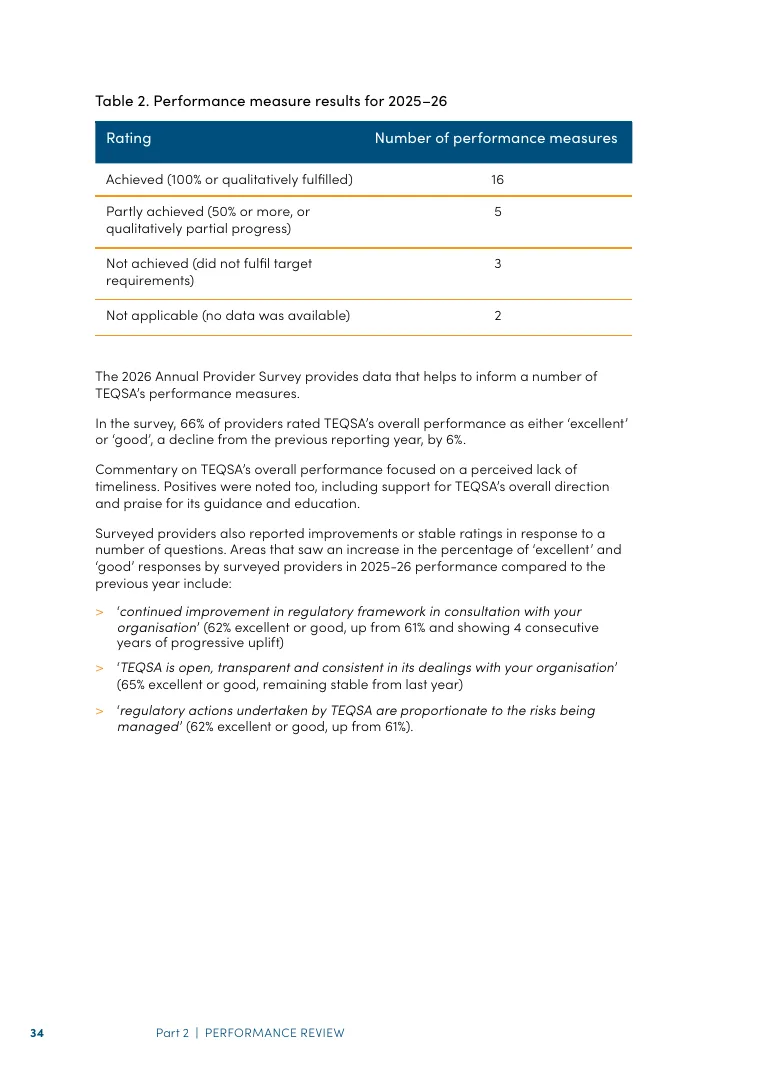
TEQSA set itself 26 performance measures in its Corporate Plan 2025-29. In 2025-26 it achieved 16, partly achieved 5, did not achieve 3, and recorded 2 as not applicable because no data was available (page 34). The report presents this as 21 of 26 achieved or partly achieved (page 33).
That is a reasonable result. It is also a result in which nearly one measure in five was either not achieved or had no data. The three that were not achieved are worth looking at, because they are about transparency, burden and reach. The third, on reach, is minor: visits to the Students section of the website rose 8.78 per cent against a 10 per cent target (page 47).
2. Fewer Providers Rate It Well
In the 2026 Annual Provider Survey, 66 per cent of providers rated TEQSA's overall performance as excellent or good. The report describes this as "a decline from the previous reporting year, by 6%". It does not say whether that is percentage points, and it does not give last year's figure (page 34). The comments it records focus on a perceived lack of timeliness, alongside support for TEQSA's overall direction and praise for its guidance and education.
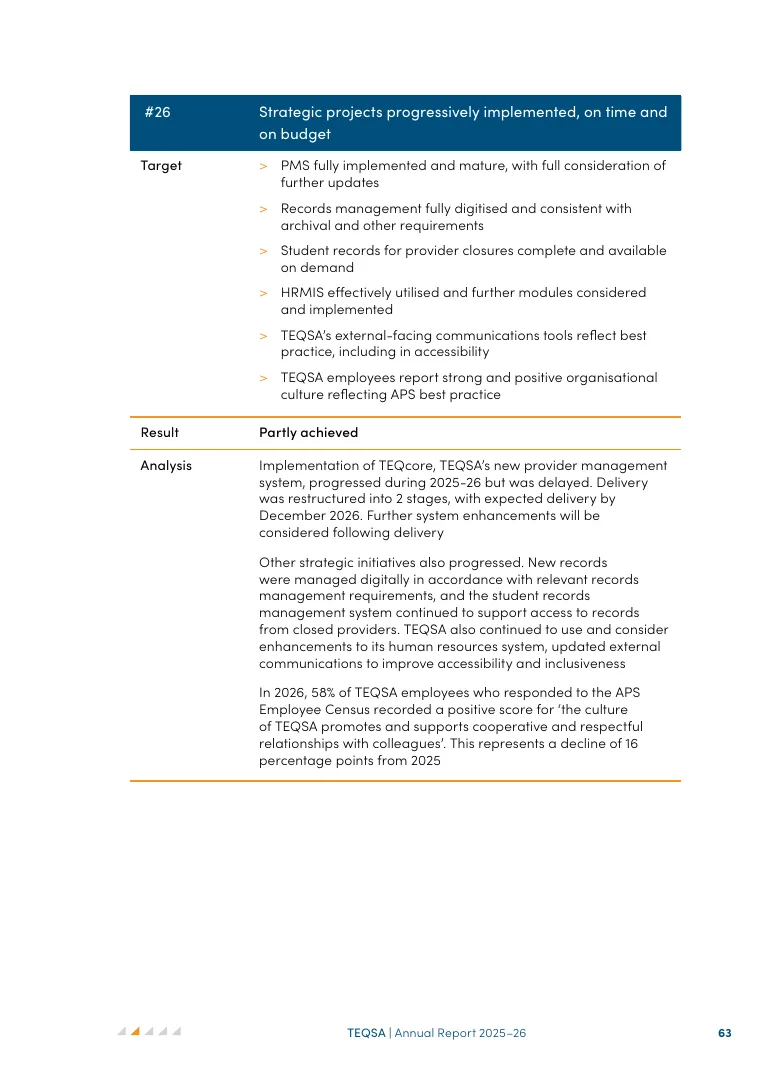
The second figure is sharper. TEQSA set a target of a 30 per cent increase in positive ratings for the statement that regulation by TEQSA does not unnecessarily impede the efficient operation of providers. The result was 51 per cent, a decrease of 5 percentage points from 2025. TEQSA rates the measure not achieved (page 60).
The target was an increase. The result was a fall. For a regulator that set itself a burden measure, fewer providers than last year agreed, in its own survey, that its regulation does not unnecessarily impede them.
To be fair, the same survey shows some steady results. Sixty-five per cent rated TEQSA open, transparent and consistent, unchanged. Sixty-two per cent rated its regulatory actions proportionate to risk, up from 61 (page 34). And the report records 322 of 325 assessments (99 per cent) completed within legislative deadlines, the other three within approved extensions (page 61). Those are real strengths and they should be said.
3. The Compliance Report Did Not Appear
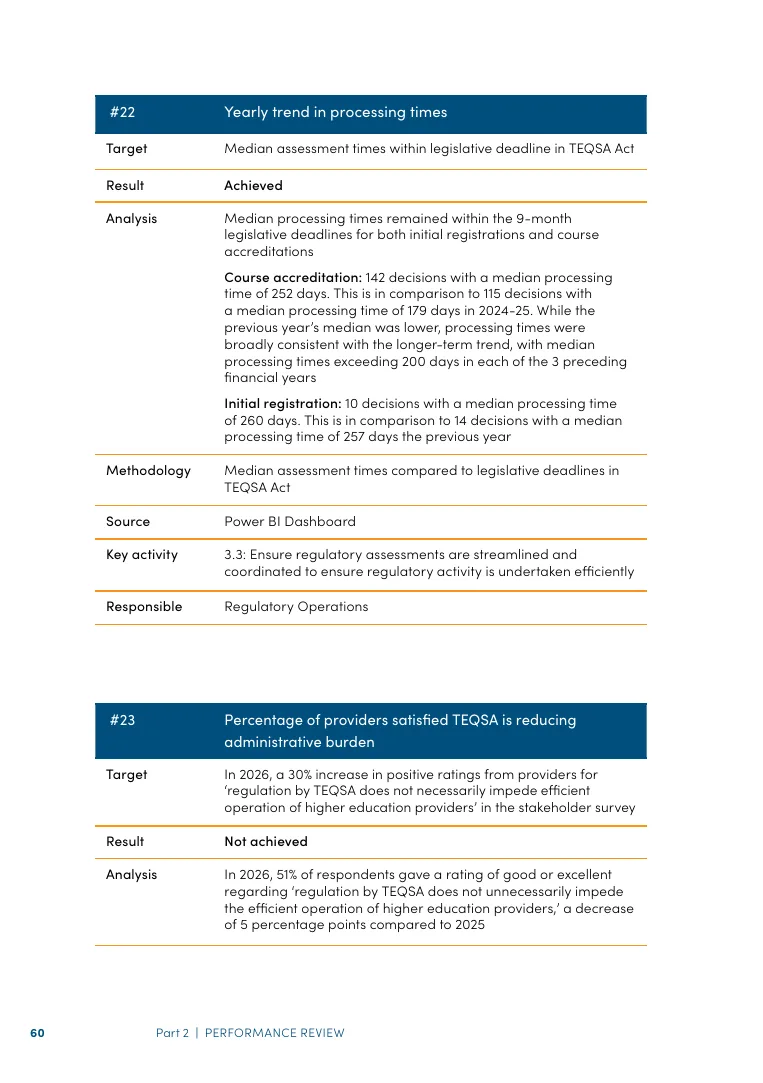
TEQSA set a measure to publish its annual Compliance Report by 30 March and its Annual Report by 30 September. It rates this not achieved. The Annual Report 2024-25 was tabled on 3 October 2025, within the statutory deadline but after TEQSA's own 30 September target. The Compliance Report was not published by 30 March, and TEQSA says it is moving to alternative approaches for communicating compliance priorities and regulatory insights (page 51).
The Compliance Report is the document in which the sector learns what the regulator has found. A regulator that asks providers to publish on time, and gives itself a date, has to explain what replaces it. The report says alternative approaches are coming, "with the aim of better reflecting current and emerging sector risks", but not what they are or when.
4. The Culture Score Fell 16 Points
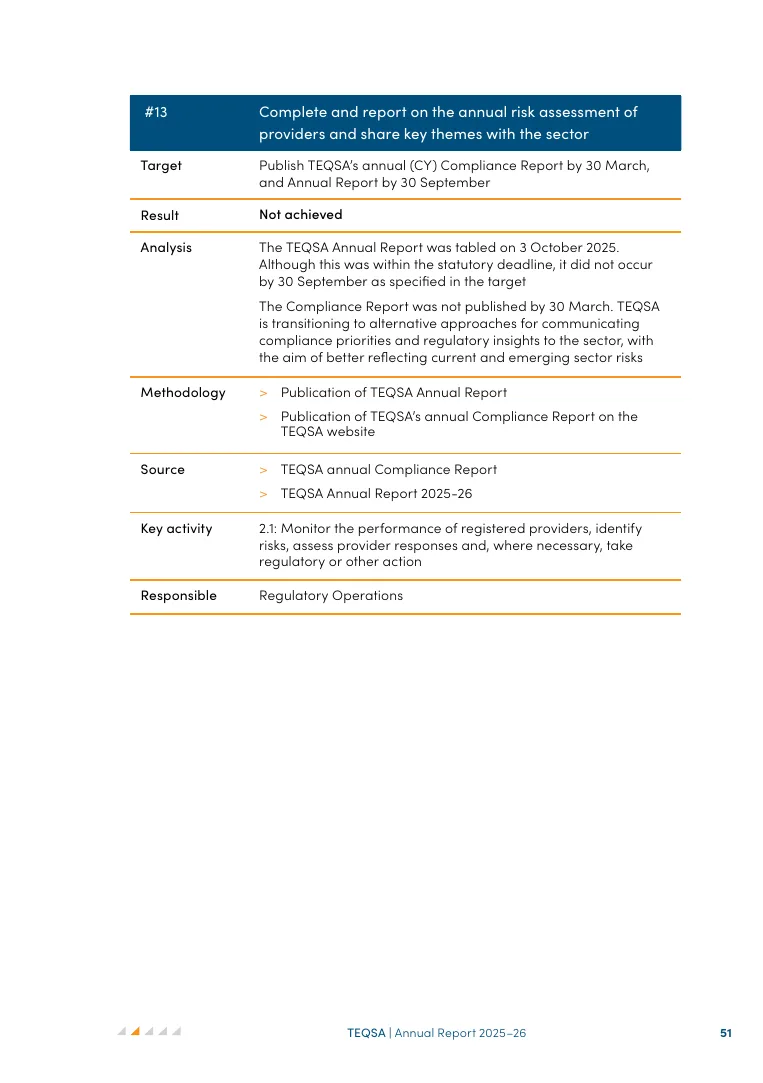
One of the corporate measures asks for increased satisfaction with organisational culture, using the APS Employee Census statement that the culture of TEQSA promotes and supports cooperative and respectful relationships with colleagues. In 2026, 58 per cent of TEQSA employees who responded gave a positive score. The Annual Report states this is a decline of 16 percentage points from 2025 (page 63). It sits inside a measure on strategic projects, which TEQSA rates partly achieved.
TEQSA's own 2026 APS Employee Census Highlights Report (page 24) shows a different result for the same statement: 55 per cent positive, down 27 points from 2025. The two documents do not agree, and the Annual Report does not explain the difference. I give both figures because both are published by TEQSA.
The census highlights report also ranks TEQSA 111 of 112 participating agencies on the Employee Engagement Index and 112 of 112 on the Immediate Supervisor Index. Ninety-five of its 116 staff responded (82 per cent), so each percentage point is about one person. These are staff perceptions, not findings of misconduct. They are also published by the regulator itself.

What This Means for Providers
I do not criticise the people who work at TEQSA. The report shows a regulator meeting its statutory deadlines in 99 per cent of cases while its staff survey scores and its provider ratings both fell. The people are not the question. Leadership, direction and follow-through are.
The pattern matches what the ASQA census showed. Staff say what is wrong. The regulator publishes it. The same questions remain. Providers who work with TEQSA and ASQA are entitled to ask the same thing of them that they are asked: show the target, show the evidence, show what changed.
Three Questions for Government
- TEQSA's target for burden was a 30 per cent increase in positive ratings. The result was a decrease. What will be different next year, and who is accountable?
- What replaces the annual Compliance Report, and when?
- What is the plan, with dates and an owner, for a 16 point fall in culture scores?
References and Further Reading
- TEQSA. Annual Report 2025-26, pages 33, 34, 47, 51, 60, 61 and 63, and the 2026 census highlights report, page 24.
- TEQSA. Annual Report 2025-26 is available
- TEQSA. APS Employee Census 2026 Highlights Report